


Thursday, 26 February 2026
MARKET ANALYSIS
System Liquidity (Nigeria)
System liquidity opened the session in surplus at ₦3.53 trillion, representing an increase of ₦416.00 billion compared to the previous day. The improvement was largely driven by higher Deposit Money Banks (DMBs) placements at the CBN’s Standard Deposit Facility (SDF), which rose to ₦3.97 trillion, despite the settlement of ₦524.27 billion from the February 2026 bond primary market auction.
Meanwhile, the CBN conducted an OMO auction, offering ₦600 billion across the 6-, 104-, and 167-day tenors, but ultimately allotted ₦1.11 trillion across the three maturities, reflecting strong investor demand.
As a result, average funding costs eased by 5bps to 22.08%. The Open Repo Rate (OPR) remained unchanged at 22.00%, while the Overnight Rate (OVN) declined by 10bps to 22.15%.
Projection: With an anticipated ₦1.11 trillion liquidity outflow from the OMO settlement, we expect system liquidity conditions to moderate in the next session, which could exert mild upward pressure on funding rates.

Source: CBN
Eurobonds
The African Eurobond market traded on a positive note, rebounding from the previous session’s risk-off sentiment. The recovery was supported by softer EU January CPI data of 1.7% (vs. 1.9% in December 2025), which strengthened expectations of a potential rate cut by the ECB. Sentiment was further influenced by renewed concerns over possible oil supply disruptions stemming from escalating tensions between the U.S. and Iran.
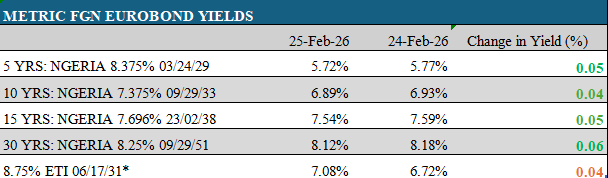
Across Nigeria’s Eurobond curve, yields trended lower.
At the short end, the Nov-2027 eased by 1bp to 5.20%, while Sep-2028 and Mar-2029 declined by 4bps and 5bps to 5.46% and 5.72%, respectively.
Mid-tenors also firmed, as Feb-2030 and Jan-2031 fell by 2bps and 5bps to 6.05% and 6.37%, respectively.
At the long end, the rally persisted, with Jan-2036 dropping 9bps to 7.33%, while Dec-2034 declined to 7.19%.
Overall, the average Nigerian Eurobond benchmark yield eased by 4bps to 6.88%, reflecting improved investor appetite across the curve.
Projection: We anticipate market performance to remain closely tied to movements in oil prices and incoming macroeconomic data.
Source: INVESTING.COM,AIICO Capital
Treasury Bills
The NTB secondary market traded on a subdued note today, as investor attention shifted toward the NTB auction conducted during the session. Activity across the curve remained muted, with rates largely stable across most maturities amid balanced demand and supply conditions.
Selective demand was evident at the longer end, where the 04-Feb-27 bill declined by 15bps to settle at 15.40%. Meanwhile, short- to mid-tenors closed flat as market participants adopted a cautious approach.
As a result, the average benchmark rate edged lower by 1bp to close at 16.06%.
Projection: We expect market sentiment to remain measured in the near term, with liquidity dynamics and investor positioning likely to determine the direction of yields along the curve.

Source: FMDQ
FGN Bonds
The FGN bond secondary market traded on a mixed but broadly bullish note, as selective buying interest drove notable yield compressions across key mid-tenor and long-dated maturities, while most other benchmarks remained relatively stable.
At the short end, yields were largely unchanged, with the 17-Mar-27 and 23-Feb-28 papers closing flat, while the 20-Mar-27 and 20-Mar-28 maturities edged marginally lower.
Across the mid-segment, the 17-Apr-29 and 26-Apr-29 bonds recorded mild yield compressions. In contrast, the 21-Feb-31 and 27-Apr-32 papers weakened, with yields ticking higher amid selective profit-taking.
Further along the curve, sentiment strengthened as the 18-Jul-34, 27-Mar-35, and 18-Mar-36 bonds posted sharp yield declines. The rally extended to the 18-Apr-37 and 21-Jun-38 maturities, alongside other longer-dated instruments.
Overall, the average benchmark yield declined by 29bps to close at 15.44%, reflecting improved demand conditions despite pockets of weakness along the curve.
Projection: In the near term, we expect the market to retain a cautious tone, with trading activity likely to remain selective amid evolving liquidity conditions and investor positioning.

Source: FMDQ
Nigerian Equities
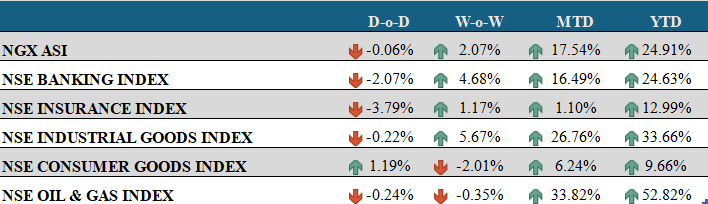
The Nigerian bourse closed the session on a negative note, as the All-Share Index (ASI) declined by 6bps. Despite the pullback, the market remains firmly positive with a 24.91% year-to-date (YTD) return. Similarly, the Pension Index shed 95bps on the day but continues to reflect a strong 32.65% YTD gain.
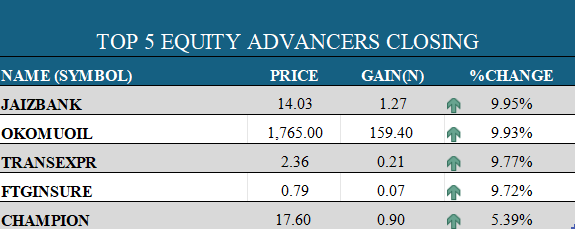
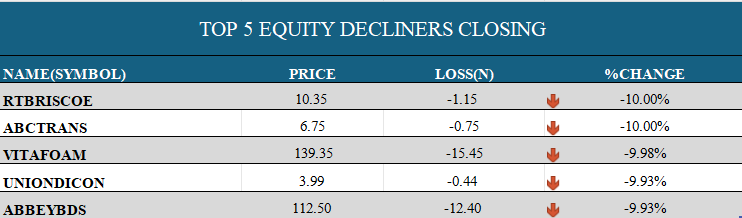
Market breadth was weak, with 21 gainers against 54 decliners. OKOMUOIL (+9.93%) led the gainers, while RTBRISCOE (-10.00%) and ABCTRANS (-10.00%) topped the losers’ chart.
Trading activity was notable, as FTGINSURE (193.69 million shares) recorded the highest volume, while ZENITHBANK (₦11.07bn) dominated the value chart.
Sectoral performance was broadly negative:
- The Banking Index declined by 207bps, weighed down by losses in UBA (-2.39%), ZENITHBANK (-2.15%), GTCO (-1.67%), ACCESSCORP (-1.48%), and FIDELITYBK (-0.49%). However, WEMABANK (+1.49%) and FCMB (+1.85%) posted gains.
- The Consumer Goods Index advanced by 119bps, supported by CHAMPION (+5.39%), BUAFOODS (+3.47%), and DANGSUGAR (+3.45%). Nonetheless, declines in INTBREW (-1.02%), HONYFLOUR (-1.08%), NB (-1.84%), CADBURY (-3.04%), PZ (-3.85%), and VITAFOAM (-9.93%) moderated the upside.
- The Oil and Gas Index lost 24bps, pressured by declines in JAPAULGOLD (-9.74%) and OANDO (-4.30%), while ETERNA (+1.23%) provided some support.
- The Industrial Index dipped 22bps, dragged by CUTIX (-5.67%), although WAPCO (+1.43%) posted gains.
Trade value declined by 14.74% to $33.24 million, with banking stocks accounting for a significant portion of activity amid mild profit-taking, resulting in overall negative sentiment.
Projection: We expect mixed market performance in the next session, as participants engage in profit-taking and portfolio repositioning.
Source: NGX
Commodities
Global oil prices slipped into negative territory on Wednesday, as a larger-than-expected build in U.S. crude inventories outweighed concerns about potential supply disruptions stemming from escalating tensions between the U.S. and Iran.
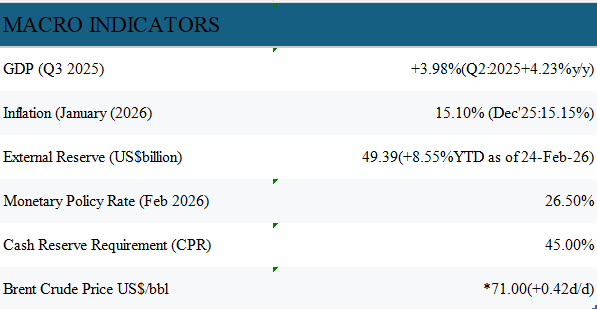
Brent crude declined by 12bps (8 cents) to hover around $71.14 per barrel, while U.S. West Texas Intermediate (WTI) edged higher by 60bps to approximately $65.55 per barrel.
Conversely, gold prices advanced as demand for safe-haven assets strengthened amid persistent uncertainties surrounding U.S.–Iran negotiations and the possibility of military escalation that could disrupt global supply chains. Spot gold gained 64bps to trade around $5,180.91/oz, while U.S. gold futures rose 44bps to approximately $5,199.16/oz.
Projection: We expect metals to continue trading in line with evolving macroeconomic developments and geopolitical risk sentiment, while oil prices remain exposed to structural supply dynamics and inventory trends.
Source: INVESTING.COM,NBS,CBN, Bloomberg
Foreign Exchange
The Naira at the Nigerian Foreign Exchange Market (NFEM) extended its negative trend into the new week, depreciating by 5bps (₦0.74) against the U.S. Dollar. The weakness was largely driven by elevated USD demand pressures, despite sustained inflows from Foreign Portfolio Investors (FPIs) and domestic market participants.
During the session, the Naira traded within a range of ₦1,353.00/$ to ₦1,361.50/$, before settling at ₦1,356.11/$. Meanwhile, external reserves rose to $49.39 billion as of 24 February 2026, reflecting a day-on-day increase of $120.05 million.
Projection : We expect the Naira to trade at relatively weaker levels in the next session, supported by prevailing demand–supply dynamics in the FX market.

Source: CBN,INVESTING.COM
