

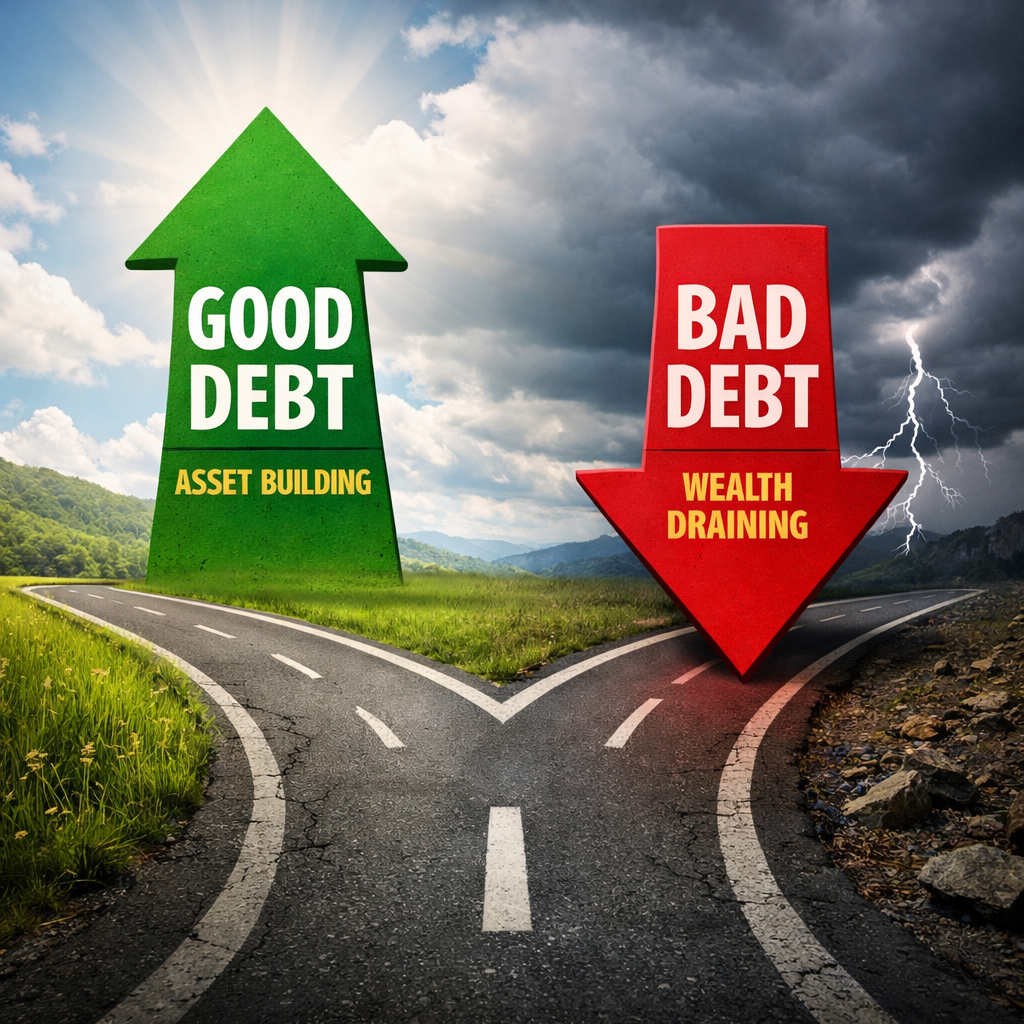

Debt is often treated like a financial four-letter word. We are constantly told to “get out of debt,” “stay out of debt,” and avoid it at all costs. But the truth about debt is much more nuanced.
In the world of finance, debt is simply a tool. Like a hammer, it can be used to build a beautiful house, or it can be used to smash your thumb. The wealthiest people and the most successful companies in the world use debt to their advantage every single day.
The secret isn’t avoiding debt entirely; it’s learning how to distinguish between Good Debt and Bad Debt. Here is everything you need to know to make debt work for you, rather than against you.
What is “Good Debt”?
Good debt is money you borrow to purchase an asset that will increase in value over time or generate income. Think of it as an investment in your financial future. Good debt typically comes with lower interest rates and helps you build a higher net worth in the long run.
Examples of Good Debt:
- A Mortgage: Buying a home is the classic example of good debt. Real estate historically appreciates in value over time. Plus, you are paying down the principal balance each month, effectively building equity (ownership) in an asset, rather than paying a landlord.
- Student Loans (Within Reason): Borrowing money to pay for higher education or specialized training can drastically increase your lifetime earning potential. However, the caveat is that the debt must be proportionate to the expected starting salary of your chosen career.
- Business Loans: Borrowing money to start or expand a profitable business is leveraging someone else’s money to create your own wealth. If the business generates more profit than the cost of the loan, it’s a brilliant use of debt.
What is “Bad Debt”?
Bad debt is money borrowed to purchase depreciating assets—things that lose value the moment you buy them. Bad debt drains your wealth, restricts your monthly cash flow, and typically comes with brutally high interest rates.
Examples of Bad Debt:
- High-Interest Credit Card Balances: Using a credit card isn’t inherently bad (especially if you pay it off in full every month to earn rewards). But carrying a balance from month to month at 20% to 25% APR is financial quicksand. You end up paying significantly more for clothes, dinners, and vacations than they actually cost.
- Payday Loans & Cash Advances: These are predatory loans with astronomical interest rates (sometimes exceeding 400% APR). They trap borrowers in a vicious cycle of debt and should be avoided at all costs.
- Financing Expensive Consumer Goods: Taking out a personal loan to buy a designer wardrobe, a massive TV, or a luxury vacation is a prime example of bad debt. You are paying interest on items that will be worth zero in a few years.
The “Gray Area” Debt
Not all debt fits perfectly into the “good” or “bad” categories. Sometimes, debt falls into a gray area depending on how it is used.
- Car Loans: A car is a depreciating asset—it loses value the second you drive it off the lot. Therefore, taking out a massive loan for a luxury car is bad debt. However, if you live in an area without public transit and need a reliable $10,000 car to get to your $60,000-a-year job, a modest car loan with a low interest rate is a necessary tool to generate income.
- Debt Consolidation Loans: Taking out a personal loan to pay off multiple high-interest credit cards can be smart—if it lowers your overall interest rate and if you actually fix the spending habits that caused the credit card debt in the first place.
How to Manage Your Debt Like a Pro
Now that you know the difference, how should you handle the debt you currently have?
1. Audit Your Debt
Sit down and make a list of every single debt you owe. Write down the total balance, the minimum monthly payment, and—most importantly—the interest rate. Label each one as “Good,” “Bad,” or “Gray.”
2. Attack the Bad Debt First
Any debt with an interest rate above 7% or 8% (especially credit cards) needs to be destroyed as quickly as possible. Use the Debt Avalanche Method: continue making minimum payments on all your debts, but throw every extra dollar you have at the debt with the highest interest rate. Once that’s paid off, move to the debt with the next highest rate.
3. Let Good Debt Do Its Job
If you have a mortgage at a 4% interest rate, there is no need to panic and sacrifice your lifestyle to pay it off early. Historically, you can earn a 7% to 10% return by investing your extra money in the stock market (like an S&P 500 index fund). You are mathematically better off investing your extra cash rather than aggressively paying off low-interest “good” debt.
The Bottom Line
Debt is not the enemy; uninformed borrowing is the enemy. By eliminating high-interest bad debt and carefully leveraging good debt to buy appreciating assets, you transition from working for your money to having your money (and your lender’s money) work for you.
