


CBN Cuts Interest Rate to 26.5%: What It Means for Your Money, Loans, and Investments
The Central Bank of Nigeria (CBN) has just announced its latest monetary policy decisions, reducing the benchmark interest rate while holding other key parameters steady. Here’s what you need to know.
At its 304th Monetary Policy Committee (MPC) meeting held on Tuesday, February 24, 2026, the CBN delivered a significant policy shift, the first rate cut in the current economic cycle. The decision signals growing confidence in the economy’s direction while offering relief to borrowers and new considerations for savers and investors.
The New Rates at a Glance
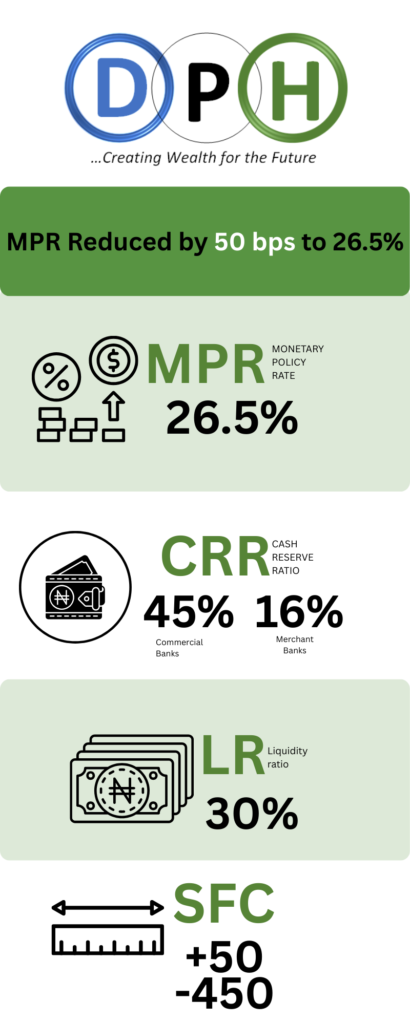
The MPC reduced the Monetary Policy Rate (MPR) by 50 basis points to 26.5%, marking a cautious beginning to what analysts describe as an “easing cycle.” All other major policy instruments were retained at their previous levels.
The retention of the Cash Reserve Ratio (CRR) at a high 45% for commercial banks is particularly noteworthy. It suggests the CBN is committed to a “cautious easing” approach preventing banks from having excessive cash to lend immediately, thereby ensuring the rate cut doesn’t inadvertently reignite inflationary pressures.
Why the CBN Cut Rates Now
The decision wasn’t made lightly. According to the MPC’s communiqué, the rate cut is based on a “balanced evaluation of risks” and growing confidence that the worst of Nigeria’s inflation battle is behind us. Three key factors drove this decision:
1. Declining Inflation
Nigeria’s headline inflation rate has been on a sustained downward trajectory, falling to 15.1% in January 2026. This marks the 11th consecutive month of decline, giving policymakers the confidence to begin moderating the aggressive tightening stance that has characterized the past two years.
2. Exchange Rate Stability
The Naira has shown remarkable strength and stability in the foreign exchange market. This stability is underpinned by robust capital inflows and significantly improved foreign reserves, reducing the need for high interest rates to defend the currency.
3. Improved External Sector
Higher export earnings, particularly from crude oil and non-oil sectors, combined with increased remittance inflows from Nigerians abroad, have contributed to greater macroeconomic stability. This improved external position provides the CBN with greater policy flexibility.
What This Means for Your Finances
The ripple effects of this policy shift will be felt across the financial landscape. Here’s how it impacts different aspects of your financial life.
For Investment and Saving
FGN Bonds: Lock in Yields Now
This rate cut signals that we are at or very near the peak of the interest rate cycle. Consequently, yields on fixed-income instruments like FGN bonds are expected to begin declining in the coming months.
This has already triggered a market response. The recent FGN bond auction saw massive oversubscription as savvy investors rushed to lock in the current high yields before they fall further. If you’ve been considering adding FGN bonds to your portfolio, acting quickly may be beneficial to secure the current rates.
Savings and Fixed Deposits: Returns to Diminish
As the MPR serves as the benchmark for interest rates across the economy, this reduction will likely lead to a gradual decline in interest rates for savings accounts and fixed deposits.
The era of ultra-high returns on cash is beginning to moderate. The massive demand for Commercial Papers (CPs) observed in recent weeks ahead of this rate cut is a clear sign that institutional investors have been trying to lock in double-digit returns before they start to fall.
For Borrowing and Loans
Cheaper Credit on the Horizon
The primary aim of reducing the MPR is to make borrowing cheaper stimulating economic activity by reducing the cost of capital for businesses and individuals.
While the effect may not be instantaneous (banks typically take time to adjust their lending rates), you can expect lending rates to edge lower over time. This is a particularly positive signal for:
- Businesses looking to finance expansion, purchase equipment, or fund working capital
- Entrepreneurs seeking to launch or scale ventures
- Individuals considering mortgages, car loans, or personal loans for major purchases
- Agricultural and manufacturing sectors that rely heavily on credit for operations
The retained high CRR of 45% ensures that banks cannot go on a lending spree immediately, but the directional signal from the CBN is clear: the era of rising rates has ended, and borrowing costs should gradually trend downward.
For the Broader Economy
Stimulating Growth
The rate cut is ultimately about growth. With inflation moderating and the Naira stable, the CBN is pivoting toward supporting economic expansion. Cheaper credit should, over time, translate to:
- Increased business investment
- Higher consumer spending
- Job creation
- Improved manufacturing output
Currency Considerations
Some analysts had worried that a rate cut might weaken the Naira by reducing foreign portfolio inflows attracted by high yields. However, the CBN appears confident that the improved external reserves and structural reforms in the FX market will maintain stability despite the modest rate reduction.
Expert Reactions
Market reactions to the MPC decision have been largely positive, with analysts describing the move as “well-timed” and “appropriately cautious.”
